
A bulging disc occurs when spinal disc tissue extends beyond the normal edges of the vertebrae over a relatively broad portion of the disc’s circumference.
Discs naturally change over time. Aging, mechanical loading, degeneration and other factors can contribute to disc bulging.
Unlike a focal disc herniation, a generalized disc bulge involves a broader portion of the disc. A bulge does not necessarily mean the disc has torn or ruptured.
Many people have bulging discs on MRI without experiencing pain.
Yes, in some situations. A bulging disc may contribute to symptoms when it is associated with inflammation, nerve irritation or narrowing around sensitive spinal structures.
Possible symptoms include:
However, an MRI finding alone does not establish the source of pain. Your symptoms, examination and imaging findings need to be considered together.
Although these terms are sometimes used interchangeably, they describe different disc shapes.
A generalized disc bulge involves more widespread extension of disc tissue, while a herniation involves localized displacement.
Neither finding automatically means you need surgery. Read our Disc Herniations page for a more detailed explanation of protrusions and extrusions.
Many bulging discs can be managed conservatively.
Depending on symptoms and clinical findings, management may include exercise rehabilitation, movement modifications, medical treatment and other appropriate conservative approaches.
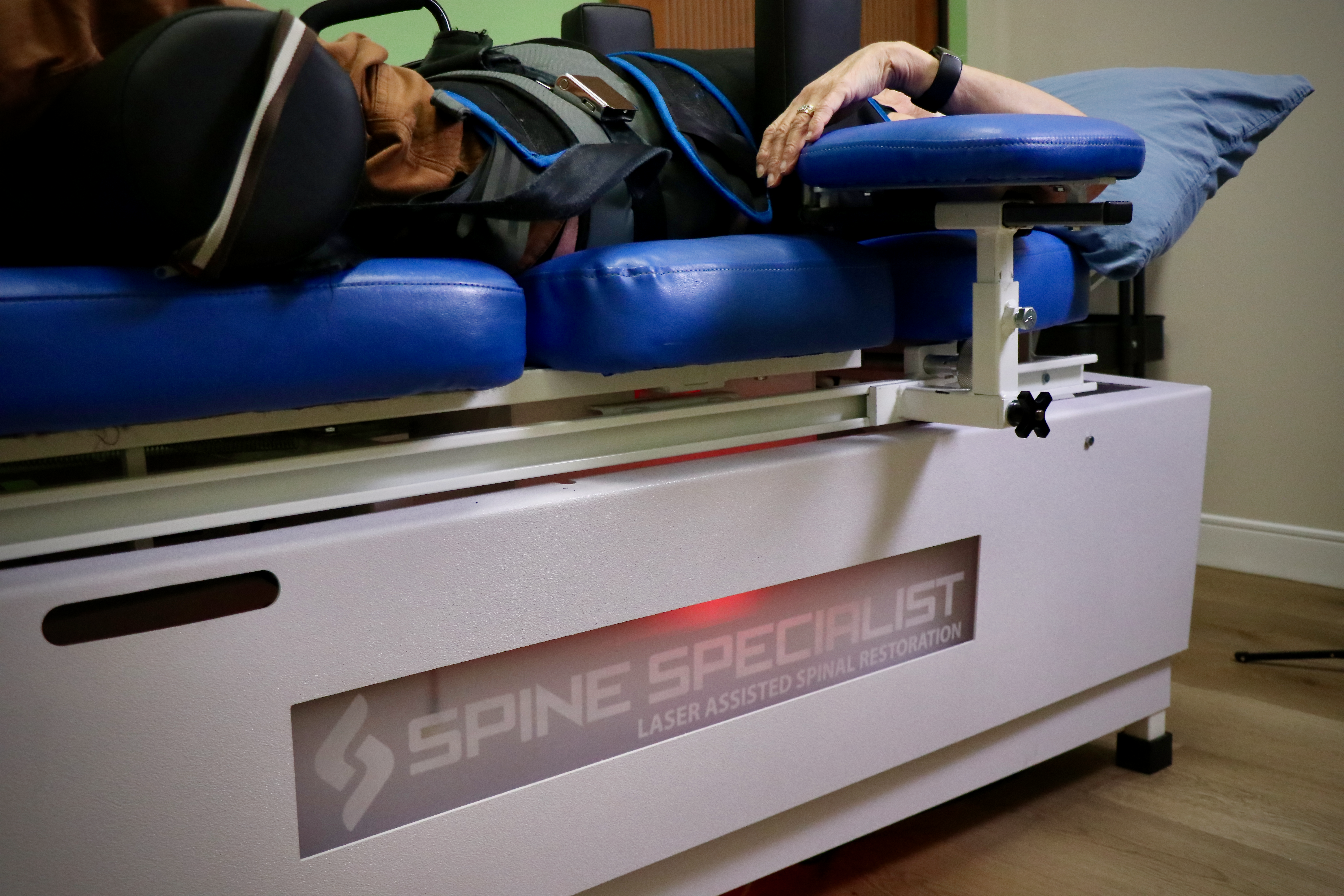
At Laser Spinal Decompression Clinic, we also assess selected patients for non-surgical spinal decompression combined with robotic Class 4 laser therapy.
Our computer-controlled decompression system uses programmed pulling, holding and releasing cycles to apply carefully controlled forces to the spine.
A robotic Class 4 therapeutic laser is delivered simultaneously. Only the laser is robotic; the decompression itself is not robotic. Laser therapy is used to help manage pain, inflammation and surrounding muscle discomfort, with research investigating additional tissue-repair mechanisms.
The goal is to help manage symptoms and improve function. Individual results vary, and treatment is not appropriate for every bulging disc.
Learn more about our spinal decompression and robotic Class 4 laser service. Our Research page explains clinical case reports and their limitations.
Patients experiencing persistent disc-related symptoms, recurring pain or inadequate improvement following previous care may wish to explore additional conservative options.
We review health history, symptoms, neurological concerns and available imaging before recommending further assessment.
New loss of bowel or bladder control, difficulty urinating, saddle numbness or progressive neurological weakness requires immediate emergency assessment. These may be signs of cauda equina syndrome or another serious neurological condition. Do not delay emergency care to book a routine consultation.
Not necessarily. Many disc bulges are found incidentally. Their significance depends on symptoms, neurological findings and the surrounding spinal anatomy.
Symptoms often improve with appropriate conservative management, even when structural findings remain visible on imaging.
No. The terms describe different patterns of disc displacement.
New loss of bowel or bladder control, difficulty urinating, saddle numbness or progressive neurological weakness requires immediate emergency assessment.
If you’re struggling with persistent back, neck or radiating pain and would like to explore whether our approach may be appropriate, begin with a complimentary phone consultation. This is for non-emergency concerns.