New or worsening bowel or bladder dysfunction, difficulty urinating or urinary retention, saddle numbness, or progressive leg weakness requires immediate emergency medical assessment. Go to the nearest emergency department. If you cannot get there safely, call 911. Do not wait for a routine phone consultation, a clinic appointment, or a trial of non-surgical treatment.
Compression of the nerves in the lower spine can sometimes affect bowel and bladder function. The sacral nerve roots, particularly S2, S3 and S4, contribute to the neurological control of bowel and bladder function. Significant compression affecting these nerves may interfere with normal sensation and control.
However, most bulging or herniated discs do not cause bowel or bladder dysfunction. Having back pain and bowel symptoms at the same time does not prove that a disc is responsible. These symptoms can have other causes and need appropriate assessment.
New or worsening bowel or bladder dysfunction, urinary retention, saddle numbness, or progressive neurological weakness may indicate cauda equina syndrome, a potentially serious neurological emergency requiring immediate medical evaluation.
Non-surgical spinal decompression may be considered for selected patients experiencing disc-related back or leg symptoms, but it is not an established treatment for restoring bowel or bladder control.
The cauda equina is the bundle of nerve roots that continues below the end of the spinal cord. Serious compression of these nerves can cause cauda equina syndrome. A large lumbar disc herniation is one possible cause; other conditions can also cause compression.
Warning signs include:
Seek emergency assessment immediately if these symptoms appear or worsen. Do not wait for all of them to occur. Emergency clinicians can assess nerve function, arrange urgent imaging when indicated, and obtain specialist advice. Confirmed compressive cauda equina syndrome may require urgent surgery. Non-surgical spinal decompression and laser therapy are not treatments for this emergency and must not delay medical care.
Read more from the American Association of Neurological Surgeons on cauda equina syndrome.
Bowel and bladder function relies on coordinated signals between the brain, spinal cord, peripheral nerves, and pelvic muscles. The bowel also has its own local nerve network. No single lumbar disc controls the entire digestive system.
The sacral nerve roots S2–S4 help carry signals involved in bladder emptying, bowel function, pelvic sensation, and control of the external sphincter muscles. These muscles help you hold and release urine and stool. Significant injury or compression involving these nerve pathways can affect sensation, emptying, or continence.
It is important to distinguish a disc level from a nerve-root level. For example, L4–L5 and L5–S1 identify spaces between spinal bones. Sacral nerve roots travel down through the lumbar spinal canal before leaving the spine. A sufficiently large central disc herniation in the lumbar region can therefore affect several descending roots, including sacral roots. This does not mean that the L4 or L5 nerve root itself is the main controller of bowel function.
For additional anatomical background, see Neural Control of the Lower Urinary Tract.
A disc bulge is an extension of the disc beyond its usual boundary. A herniation involves displacement of disc material that may irritate or compress nearby nerves. Some disc changes cause no symptoms; others are associated with back pain or leg symptoms such as pain, tingling, or numbness.
Bowel or bladder dysfunction is not a typical symptom of an uncomplicated disc bulge. The significance of an imaging finding depends on its location, the nerves involved, and how it fits with the person’s symptoms and examination. An MRI report showing a bulging disc does not, by itself, explain constipation or urinary symptoms.
Constipation, urgency, leakage, and changes in bowel habits can occur for reasons unrelated to spinal nerve compression. Possible contributors include medication effects, dietary or fluid changes, reduced activity, digestive disorders, urinary conditions, and pelvic floor problems.
Constipation alone does not establish cauda equina syndrome or prove that a disc is affecting the bowel. Persistent or unexplained symptoms deserve medical evaluation rather than an assumption that spinal treatment will resolve them. New loss of control, urinary retention, saddle numbness, or progressive weakness should follow the emergency pathway described above.
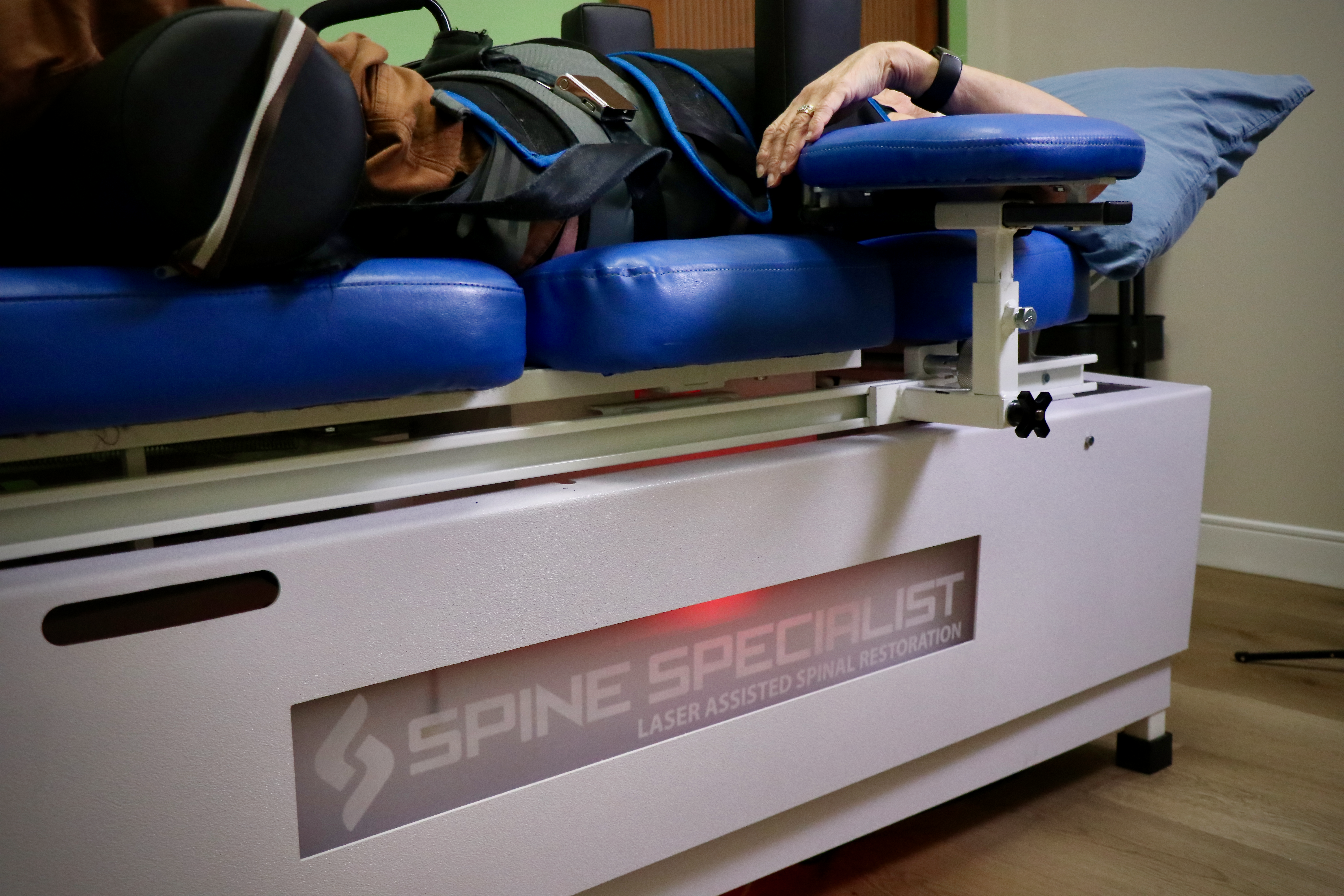
After urgent conditions have been excluded, non-surgical spinal decompression may be considered for appropriately selected patients with certain disc-related back or leg symptoms. It uses mechanical traction as part of a treatment plan. Suitability depends on the diagnosis, examination, medical history, and relevant imaging; it is not appropriate for everyone.
Non-surgical spinal decompression is not an established treatment for bowel or bladder dysfunction and should not be presented as a way to restore continence or treat cauda equina syndrome. Improvement in back or leg pain does not establish that bowel or bladder nerve function has recovered. Outcomes vary, and recovery cannot be guaranteed.
At Laser Spinal Decompression Clinic in Winnipeg, we review patient symptoms, history, and available imaging to assess whether care may be appropriate. We refer patients for appropriate medical evaluation when indicated. Warning signs suggesting a neurological emergency require emergency assessment rather than routine clinic treatment.
Our technology consists of a robotic Class 4 laser used simultaneously with non-surgical spinal decompression. The robotic component is the laser; the decompression itself is not robotic. This combination is not an established treatment for restoring bowel or bladder control, and we do not promise nerve regeneration, guaranteed recovery, or avoidance of medically necessary surgery.
For persistent back or leg symptoms without emergency warning signs, an individual assessment can help clarify treatment options and limitations. Bowel and bladder concerns need their own appropriate medical evaluation.
Significant compression of the nerve pathways involved in bowel function can affect bowel emptying, but most disc bulges do not cause this. Constipation has many possible causes. An assessment is needed to determine the cause; it should not automatically be attributed to a disc.
The sacral nerve roots, particularly S2, S3 and S4, contribute to sensation and control alongside other nervous-system pathways. These nerve roots are different from the lumbar disc levels described on an imaging report.
Neither should be offered as an established treatment for restoring bowel or bladder control or for cauda equina syndrome. Treatment for bowel or bladder dysfunction depends on its cause and requires appropriate medical evaluation.
No. Seek immediate emergency medical assessment. A routine phone consultation is not a substitute for assessment of urinary retention, new loss of control, saddle numbness, or progressive neurological weakness.
Dr. Suzanne Buffie is a chiropractor at Laser Spinal Decompression Clinic in Winnipeg. The clinic assesses treatment suitability for people with spinal symptoms and refers for medical evaluation when indicated.
Important: Any routine consultation links on this page are for non-emergency care. If you have new or worsening bowel or bladder dysfunction, difficulty urinating, saddle numbness, or progressive weakness, go to an emergency department now rather than using a booking link.