When Surgery Isn’t the Only Answer for Your Spine

Dr. Suzanne Buffie

Table Of Contents

TL;DR: Laser spinal decompression creates negative pressure (-100 to -600 mmHg) that retracts disc herniations without surgery. Research shows 80% pain reduction and 77% disc herniation size reduction after 20 treatments over three months. This non-surgical option fills the gap between ineffective conservative care and unnecessary surgery for chronic disc-related back pain.

What You Need to Know About Non-Surgical Disc Herniation Treatment

  • The problem: Traditional treatments (chiropractic, PT, medication) only mask symptoms because they don’t create the negative pressure needed to retract disc herniations.

  • The solution: Laser spinal decompression uses cyclic pulling to create a vacuum effect that physically retracts herniated discs back into place.

  • The timeline: Minimum 24 treatments over three months produces measurable structural changes including increased disc height (1.4-1.6 mm) and expanded spinal canal space (1.5-2.1 mm).

  • Who it’s for: Patients with disc herniations, bulges, spinal stenosis, or degenerative disc disease who’ve exhausted traditional options but want to avoid surgery.

  • The outcome: 86% of patients with ruptured discs achieve good-to-excellent results, compared to only 55% with traditional traction.

Why I Became a Specialist in Non-Surgical Spinal Decompression

I had my first disc herniation at age 20 while rowing on the Rutgers University crew team. That injury led me to become a chiropractor.

But here’s what nobody tells you about disc injuries: they don’t always get better with traditional care.

Despite 25 years of chiropractic treatment, I still experienced debilitating bouts of low back pain. The episodes became more frequent and more severe. One summer, I had to stop adjusting patients completely because of the pain, burning sensations, and electric shock sensations running through my body.

The last major flare-up happened while I was simply sitting on a hill watching my kids swim in the lake. The next morning, I couldn’t stand up.

My most recent MRI showed that my one disc herniation from 20 years ago had turned into four.

That progression taught me something critical about spinal disc injuries: when you have disc compression, you need spinal decompression to address the root cause. Everything else simply masks symptoms.

Bottom line: Personal experience with progressive disc herniation revealed the limitations of traditional chiropractic care for compressed discs.

What Is the Gap Between Traditional Care and Surgery?

Most people with chronic disc-related back pain find themselves in a frustrating middle ground.

Traditional conservative treatments like chiropractic adjustments, physical therapy, or medication may provide temporary relief. But the pain always comes back. Research confirms that 60-90% of lumbar disc herniation cases are treated with conservative care alone, yet many practitioners still don’t know how to address disc pathology effectively.

When conservative options fail, the medical system often presents surgery as the only remaining choice.

But there’s a significant treatment gap here. Analysis of Medicare data revealed that hospitals performed more than 200,000 unnecessary back surgeries over a three-year period. One spine surgeon reported that after careful examination, surgery is not necessary in at least 80% of cases referred for surgical consultation.

The patients I help at the Laser Spinal Decompression Clinic have been everywhere and tried everything. They’ve lost hope. They’ve been told there’s nothing else that can be done for them. Their quality of life has diminished to the point where they can’t enjoy the things they love.

They’re at the end of their rope.

The key insight: Over 200,000 unnecessary back surgeries happen annually because most practitioners don’t know how to address disc pathology effectively, leaving patients stuck between failed conservative care and premature surgical recommendations.

How Does Spinal Decompression Work?

Understanding the mechanical problem helps explain why certain treatments work and others don’t.

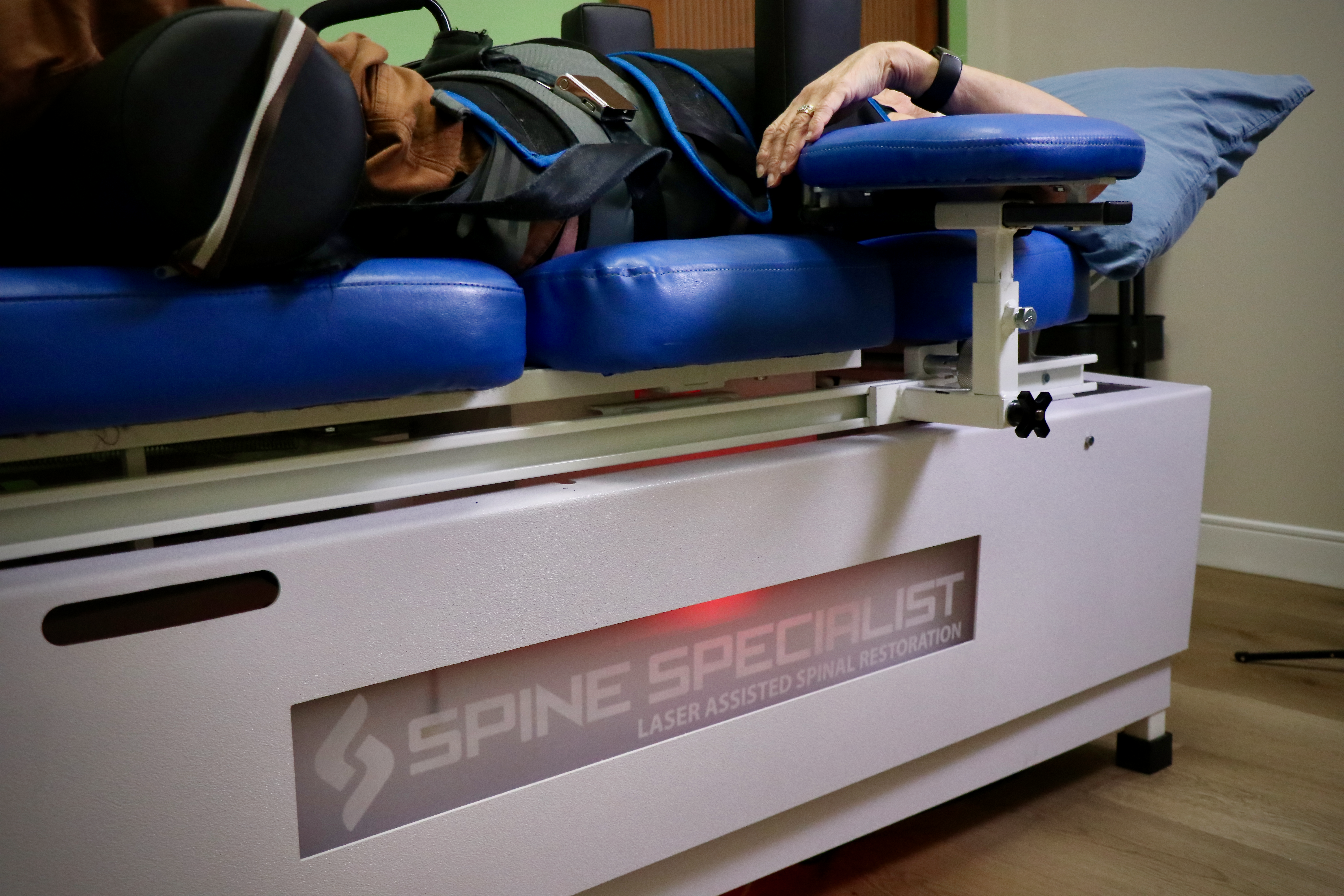
Spinal decompression uses a long, gentle pulling of the spine in a cyclic pattern: it pulls, holds, releases. Pulls, holds, releases. This repetitive motion builds up negative pressure inside the disc.

Research shows this negative pressure ranges from -100 to -600 mmHg in herniated discs. That negative pressure creates a vacuum effect over time, which helps to retract the disc herniation back into place.

This is fundamentally different from traction or inversion tables.

Traction and inversion tables may decrease pressure in the disc temporarily. They don’t create the negative pressure needed for actual disc retraction. Studies comparing the two approaches found that among patients with ruptured discs, 86% achieved good-to-excellent results with spinal decompression compared to only 55% with traditional traction.

When you have one disc herniation, it creates dysfunction at that joint. That dysfunction usually leads to issues above and below if the joint isn’t restored properly. That’s exactly what happened to me over 20 years.

We take the treatment further with the addition of a robotic class 4 laser, which works on the patient’s lower back simultaneously with the spinal decompression. The laser reduces tight muscles, decreases inflammation, creates more blood flow and energy to the area for accelerated healing, and provides some pain modulation.

Core mechanism: Spinal decompression creates negative pressure (-100 to -600 mmHg) through cyclic pulling, which retracts disc herniations—fundamentally different from traction or inversion tables that only temporarily decrease pressure.

Why Does Treatment Take Three Months?

When patients come to me at rock bottom, they’ve usually tried quick fixes that didn’t work.

I have to explain something they don’t want to hear: this takes time.

Research shows that maximum healing of a disc happens over about a three-month timeframe. The minimum effective dose is approximately 24 visits. A 2025 University of South Florida study demonstrated that after 20 non-surgical spinal decompression treatments, pain decreased by 80% and disability improved by 50%.

More significantly, MRI analysis showed a 77% quantitative reduction in disc herniation size. Disc height increased by 1.4-1.6 mm and spinal canal space expanded by 1.5-2.1 mm. These are objective structural changes, not just pain relief.

Many patients see and feel improvements within the first few weeks. That early change gives them hope and encouragement. It makes them excited to continue with the treatments because they’re feeling something they haven’t felt before.

But healing isn’t cookie-cutter. Many factors influence how one person heals compared to another.

Mindset is critical. Patients need to believe they can be well. They need to trust the process and trust that we have a solution for them. They need to commit to consistency.

Other lifestyle factors also affect results: sleep quality, stress levels, nutrition, hydration, movement habits, and daily health practices. If someone smokes, they’re much less likely to see significant results because smoking makes it nearly impossible to get nutrients into a disc.

Evidence-based timeline: Maximum disc healing occurs over three months with a minimum of 24 treatments, producing objective structural changes including 77% reduction in herniation size and 1.4-1.6 mm increase in disc height.

What Mindset Shift Is Required for Healing?

Most people in chronic pain have been conditioned by the medical system to wait for someone to fix them.

We teach patients that they are in control of their health. That shift is exciting for people who’ve been conditioned to believe they have to be reliant upon the medical system. They’ve been told that wear and tear on discs is normal aging and there’s nothing that can be done about it.

That’s not true.

The transformation happens somewhere between skeptical and cautiously optimistic. After that cautiously optimistic stage, we start to see people really experience results. They turn from grumpy, depressed, and hopeless into joyful and full of life.

I see people come in who can’t enjoy the things they love. Their pain affects their relationships, their mood, their energy, their sleep, their overall health. After they go through the treatment process, they regain joy for life. They get back to the things they love doing. They get back to work. Their relationships transform.

We give people their life back.

Critical transformation: Patients shift from passive recipients waiting to be “fixed” to active participants who believe they control their health outcomes, moving from skeptical to cautiously optimistic to fully engaged in recovery.

When Should You Consider Surgery Instead?

There’s a small percentage of people who are true surgical candidates.

I would consider referring someone to a surgeon after they’ve been through the intensive work. They completed the minimum effective dose of 24 visits. They tried to boost and accelerate their healing with additional regenerative technologies. Even after three months of intensive work, we might do another boost of daily sessions for two weeks as a final effort to initiate the healing process.

If someone has exhausted all of those conservative regenerative options, then surgical consultation may be appropriate.

Research supports this approach. Studies show that surgical and non-surgical treatments showed no significant differences in pain outcomes at three months, four years, and ten years. Surgery showed improvement at 24 months, but it came with complication rates of 10-24% compared to zero reported side effects for conservative treatments.

Surgery becomes the option after you’ve truly exhausted conservative regenerative care—not before.

Surgical timing: Surgery becomes appropriate only after completing 24+ decompression treatments, regenerative therapies, and booster sessions over three months—research shows no significant difference in pain outcomes between surgical and non-surgical approaches at three months, four years, and ten years.

What Does “Healed” Actually Mean?

My disc herniations have reduced on imaging since I started my own decompression treatments five years ago.

But healing means more than what shows up on an MRI.

Healing means that spinal unit, that joint in the spine, has better biomechanics and overall function. The discs are more nourished. It may include a reduction of the disc bulge or herniation.

Simply having disc degeneration or a disc herniation on imaging doesn’t always equate to pain. This is why doing an exam is crucial. We don’t rely solely on imaging to diagnose whether someone’s degenerated disc or disc herniation is actually causing their pain. The question is whether the disc herniation or disc degeneration is a pain generator.

By improving the functional unit in the spine—the biomechanics, the hydration, and the nourishment of that disc—we improve how that joint functions. It’s no longer a pain generator for that patient.

My actual herniation happened when I was doing deadlifts while training for the rowing team. I’m now back to doing deadlifts and squats. I love lifting heavy. I think it’s an important part of health, making sure you build, maintain, and preserve muscle as you age.

I’m back to doing those activities with no fear of injury. I don’t have those debilitating flare-ups of back pain any longer.

Functional healing: True healing means restored biomechanics and function, not perfect imaging—a disc herniation visible on MRI doesn’t equal pain if the joint functions properly and is no longer a pain generator.

What Results Do Patients Actually Experience?

When I ask patients what they’re most grateful for after completing their protocol, it’s the little things.

Being able to stand over the sink and wash dishes. Sitting on the floor to play with grandkids. Bending over to tie shoes. Getting out of bed in one motion rather than having to strategize because of pain.

Many patients get back to the sports and activities they love. Many get back to work. But it’s the little things that really matter—the daily activities that chronic pain steals from you.

Quality of life isn’t about perfection on an MRI. It’s about being able to live the life you want to live.

Real-world outcomes: Patients regain daily functional abilities (tying shoes, playing with grandkids, getting out of bed without pain) and return to work and sports, prioritizing quality of life over imaging perfection.

Who Is a Good Candidate for Laser Spinal Decompression?

During the complimentary phone consultation, we determine candidacy based on several factors: mechanism of injury, what makes the pain better or worse, what treatments they’ve tried in the past, and other considerations.

We rule out a few contraindications, though there aren’t many. The treatment is generally very safe.

We also lay out what it takes. This isn’t a one-time treatment. It requires consistency over time. We walk people through what they can expect on that journey.

This approach is not for people who just want to give it a try or who want to come in for one visit. We’re a busy clinic with limited capacity. If people are looking for a quick fix, this won’t work for them.

It takes people who believe they can be well. People who are willing to be active participants in their recovery. People who understand that three months of intensive work creates lasting change.

The patients who succeed are the ones at rock bottom—when the cost of staying the same becomes unbearable. When the price of the pain outweighs not doing anything.

Those are the people we help every day.

Ideal candidates: Patients at rock bottom who’ve exhausted traditional options, believe they can be well, and commit to 24+ treatments over three months—not those seeking quick fixes or single-visit trials.

Frequently Asked Questions

How is spinal decompression different from traction?

Spinal decompression creates negative pressure (-100 to -600 mmHg) through cyclic pulling that physically retracts disc herniations. Traction only temporarily decreases pressure but doesn’t create the vacuum effect needed for disc retraction. Research shows 86% of patients with ruptured discs achieve good-to-excellent results with decompression versus 55% with traction.

How long does it take to see results?

Many patients feel improvements within the first few weeks. However, maximum disc healing occurs over three months with a minimum of 24 treatments. A 2025 study showed 80% pain reduction and 77% herniation size reduction after 20 treatments.

Will my disc herniation show up as healed on an MRI?

Imaging may show reduction in herniation size and increased disc height (1.4-1.6 mm), but healing means restored joint function and biomechanics. A disc herniation visible on MRI doesn’t equal pain if the joint functions properly and is no longer a pain generator.

Can I just try one treatment to see if it works?

No. The treatment requires consistency over time because negative pressure builds gradually to create the vacuum effect. Single visits don’t produce results. The minimum effective dose is 24 treatments over three months.

What conditions does laser spinal decompression treat?

Disc herniations, disc bulges, spinal stenosis, disc degeneration, osteoarthritis, facet syndrome, spondylolisthesis, and other spinal compression or degenerative conditions causing chronic back pain, sciatica, neck pain, radiculopathy, weakness, numbness, or tingling.

Does smoking affect treatment outcomes?

Yes. Smoking makes it nearly impossible to get nutrients into a disc, significantly reducing the likelihood of successful treatment outcomes.

When is surgery actually necessary?

Surgery becomes appropriate only after exhausting conservative regenerative care: completing 24+ decompression treatments, regenerative therapies, and booster sessions over three months. Research shows only a small percentage are true surgical candidates, and outcomes between surgical and non-surgical approaches show no significant difference at three months, four years, and ten years.

What lifestyle factors affect healing?

Mindset (believing you can be well), sleep quality, stress levels, nutrition, hydration, movement habits, daily health practices, and smoking status all impact treatment outcomes. Patients must shift from passive to active participants in their recovery.

Key Takeaways

  • Spinal decompression creates negative pressure (-100 to -600 mmHg) that physically retracts disc herniations through cyclic pulling—fundamentally different from traction or inversion tables.

  • Research-backed results: 80% pain reduction, 77% herniation size reduction, 1.4-1.6 mm disc height increase, and 1.5-2.1 mm spinal canal expansion after 20-24 treatments.

  • Three-month commitment required: Maximum disc healing occurs over approximately three months with a minimum of 24 treatments because negative pressure builds gradually over time.

  • Fills the treatment gap: Over 200,000 unnecessary back surgeries occur annually because practitioners don’t know how to address disc pathology effectively, leaving patients stuck between failed conservative care and premature surgery.

  • Functional healing over imaging perfection: Success means restored biomechanics and pain-free function, not perfect MRI results—a visible herniation doesn’t equal pain if the joint functions properly.

  • Mindset matters: Patients must shift from passive recipients waiting to be “fixed” to active participants who believe they control their health outcomes.

  • Surgery as last resort: Research shows no significant difference in pain outcomes between surgical and non-surgical approaches at three months, four years, and ten years—surgery should only follow exhausted conservative care.

Results vary based on individual health status and treatment compliance. This information is educational; consult a healthcare professional for personal medical advice. Every patient is unique; thorough assessment precedes all recommendations.

Leave a Reply

Your email address will not be published. Required fields are marked *

Ready to reclaim
your spinal health?

Book your appointment today and experience cutting-edge spinal care and lasting relief. Visit our website or call us. Follow us on social media for updates, tips, and exclusive offers.
Robotic Laser Spinal Decompression is an innovative, non-invasive treatment designed to alleviate back pain and promote spinal health.
Contact
Laser Spinal Decompression Clinic (located inside Norwood Health and Wellness)
© 2026 Laser Spinal Decompression Clinic. All Rights Reserved